
Shaping Lifelong Health
Challenge Theme

About the Challenge
The Shaping Lifelong Health Challenge is the Central Coast Health & Wellbeing Living Lab’s new initiative, focused on prevention from midlife onwards. It brings together community members, carers, services, researchers and partners to create opportunities for people to live well and thrive into later life.
Together, we can build opportunities that make it easier for people to live well and thrive at every stage of life.
Why it matters
By age 65, two in three Australians are living with at least one chronic condition, and nearly half live with two or more (Australian Institute of Health and Welfare, 2022). Dementia is now the second leading cause of death (ABS, 2022), and social isolation remains a powerful predictor of poor health outcomes.
The good news is prevention works. Healthy habits, strong social connections and supportive environments in our 40s–60s can delay or prevent illness, frailty and decline. Every $1 invested in prevention is estimated to return about $14 in health and social benefits (Australian Government, National Preventive Health Strategy, 2021).

Our focus
This Challenge explores three key themes:
Healthy Bodies: moving well, nutrition and oral health
Healthy Minds: brain health, dementia prevention and digital inclusion
Healthy Participation: age-friendly places, purpose and contribution
What we've done together — and what's next
This Challenge has unfolded in stages, shaped by the community at every step.
Community consultation — we've been out across the Central Coast having conversations with community members, local groups, services and clinicians about what helps people stay well as they age.
Sharing insights — we've pulled those conversations together into a Community Insights Summary, capturing the priorities and themes that emerged.
Collaboration — we're now inviting services, researchers, community members and partners to propose ideas through an Expression of Interest (EOI). EOIs are open until 12 June 2026.
Piloting projects — selected projects will be supported for development and testing.
What we’ve heard
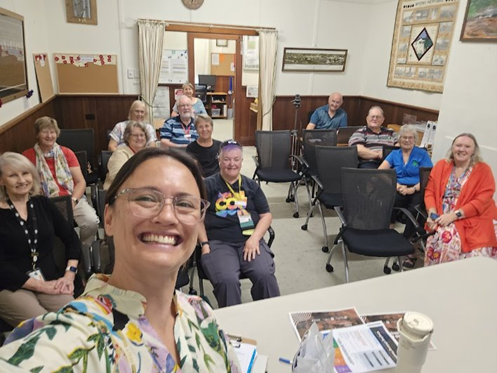
We've been speaking with community members, local groups, services, and partners across the Central Coast to understand what supports people to stay well as they age — and what gets in the way.
These insights draw on community workshops, conversations, local events, and engagement with services and stakeholders. Together, they reflect how wellbeing is experienced in everyday life, shaped not just by individual choices, but by connection, opportunity, and the environments around us.
A few things stood out
Having somewhere to go and someone to go with matters as much as the activity itself
Physical activity is more likely to stick when it’s social. The connection is often what makes the difference
Knowing what supports good health isn’t the same as being able to act on it. Cost, confidence, and not knowing where to start often get in the way
When opportunities fit around real life, people show up — timing, flexibility, and low-pressure formats make it easier to take part.
Life transitions such as retirement, bereavement, or loss of a licence can quietly disrupt wellbeing before support kicks in
What’s available, and how easy it is to find, afford, and get to, shapes what’s realistically possible for people
Explore the full insights
This is a snapshot of what we’ve been hearing across the community. The full Community Insights Summary brings together what we heard across conversations, workshops, and local engagement.
→ Read the Community Insights Summary
You can also explore the earlier community workshop that helped shape and kick off the Shaping Lifelong Health Challenge:
Get involved
We're inviting people, organisations and researchers to be part of the Shaping Lifelong Health Challenge.
This phase is about taking what we've heard from the community and developing practical ideas, partnerships, and projects that support people to stay well, independent, and connected as they age.
What the Challenge offers is partnership, facilitation, and the resources of the Living Lab: practical support to shape, test and develop ideas, community connections, and research support. The Challenge is not structured as a funding program; what it does provide is the infrastructure and relationships to help good ideas take shape. Projects that emerge can form the foundation for larger collaborations, joint funding applications, and future research.
There are different ways to get involved depending on what you're bringing, whether that's a problem or opportunity, an idea, research expertise, or your perspective as a community member.
Expressions of Interest are now closed.
Thank you to everyone who took part. Submissions are now being reviewed by a selection panel, and a small number of projects will be invited to progress with the Living Lab. We'll be in touch with everyone who submitted.
Ways to get involved
The pathways below describe the different ways people, organisations, and researchers took part.
Applications are now closed.
-
Seeing a problem or challenge you’d like to explore?
You might fit here if you’re noticing a challenge, gap, or opportunity in your organisation, service, or community and want to explore what could be done about it.
This could relate to how people stay well, maintain independence, or remain connected as they age. It may be something people are experiencing barriers with, or an opportunity to build on what is already working.
You don’t need to have a solution. In many cases, projects begin with a shared understanding of the issue before any ideas are defined.
Through the Living Lab, you’ll work with community members, researchers, and partners to better understand the situation and develop and test possible ways forward. This may involve workshops, conversations, or co-designing and testing ideas together.
Your level of involvement can vary depending on your capacity, from helping shape the project’s focus through to playing a more active role in guiding and testing an approach.
If you already have a specific idea or program you’d like to develop or test, you may prefer to apply as an Idea or Solution Partner.
-
Bringing an idea or approach you’d like to develop or test?
You might fit here if you have an idea, program, or approach that could support people to stay well, independent, or connected as they age, and you're looking to develop, refine, or test it through genuine community involvement.
Your idea could be at any stage. It might be something you’ve been thinking about, an idea or solution you’ve started working on and developing or an existing program you’d like to strengthen or adapt.
Through the Living Lab, you’ll work with community members, services, researchers, and other partners to further shape your idea and explore how it could work in practice. This may involve co-design workshops, refining the approach, or piloting the idea in a local setting.
This pathway can help you test feasibility, build evidence, and strengthen an idea to support future funding, implementation, or scale.
If you’re still exploring a need or opportunity and don’t yet have a specific idea, you may prefer to apply as a Problem or Challenge Partner.
-
Bringing research expertise or exploring research opportunities?
This pathway is open to University of Newcastle researchers interested in developing or contributing to projects through the Shaping Lifelong Health Challenge.
There are two ways to be involved:
Develop a research project through the Living Lab — you bring a research idea or question and work with the Living Lab to shape it through community and partner involvement. The Living Lab can support you with study design, participant recruitment, co-design facilitation, and running activities in community and service settings.
Contribute to a project emerging through the Challenge — you express your interest in contributing your expertise to projects led by community or service partners. This is a non-competitive register used for matchmaking. We’ll reach out if a project looks like a good fit.
You don’t need a fully developed proposal, just a research area, an idea, or a sense of how your expertise could contribute.
-
Interested in being involved and sharing your perspective?
You might fit here if you’re interested in being part of conversations, workshops, or activities that explore how people can stay well, independent, and connected as they age.
You don’t need any specific experience or background — just an interest in the topic and a willingness to share your perspectives and experiences.
As a Community Contributor, you may be invited to take part in workshops, provide feedback on ideas, or help shape and test new approaches. Your input will help ensure that projects reflect real experiences and what matters most to people in the community.
There’s no ongoing commitment — you can choose to be involved in the opportunities that interest you.
📄What happens next
Expressions of Interest closed on 12 June 2026. Submissions are now being reviewed by a selection panel. A small number of projects will be invited to progress with the Living Lab, where they'll be developed and tested alongside community members, services, researchers, and other partners.
We'll be in touch with everyone who submitted. Where a project isn't progressing this round, we'll talk with applicants about other ways their idea, interest, or expertise might connect with work across the Living Lab and the wider Central Coast Research Institute.
💬Get in touch
Have a question, or want to talk through an idea or opportunity for future work? We're happy to have a chat.
Contact Natassia Smith (CCLL Coordinator): ccll@newcastle.edu.au
Curious about how we approach innovation?
We use a Living Lab approach to bring people together to design, test, and deliver real-world solutions.